ecl-logo Documentation

ExactMass

ExactMass[molecule]mass

computes the most probable exact mass of molecule.

ExactMass[oligomer]mass

computes the most probable exact mass of a sequence, strand, or structure.

Details

  • ExactMass computes the most probable exact molecular mass arising from isotopic variation.
  • The exact mass of a molecule is a distribution of possible quantities because each atom can exist as one of multiple isotopes (with varying probability). Set OutputFormat to List or Distribution to view the full distribution of masses.
  • The MolecularWeight of a molecule is the mean of its exact mass distribution.
  • MonoisotopicMass represents the exact mass of a molecule in which each atom exists as its most frequently occurring isotope.
  • Input
    Output
    General Options

Examples

Basic Examples  (4)

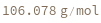
Compute the most probable exact mass of caffeine:

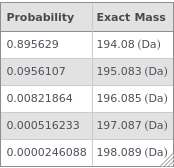
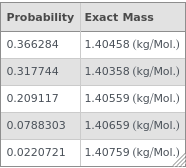
List the probabilities and exact masses for caffeine:

Compute the most probable exact mass of a Model[Molecule]:

ExactMass is listable:

Additional Examples  (9)

Input Types  (7)

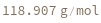
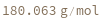
Exact mass of a DNA sequence:

Exact mass of a peptide sequence:

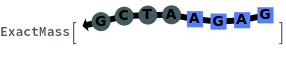
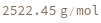
Exact mass of a strand:

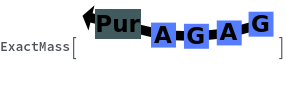
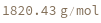
Exact mass of a strand with a modification:

Exact mass of a structure:

Exact mass of a Model[Molecule,Oligomer]:

Exact mass is listable across all valid input types:

Large Molecules:  (2)

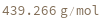
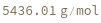
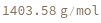
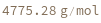
The monoisotopic mass of large molecules is often distinct from the most probable mass:

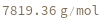
The monoisotopic mass of large molecules is often distinct from the most probable mass:

Options  (9)

ExactMassProbabilityThreshold  (2)

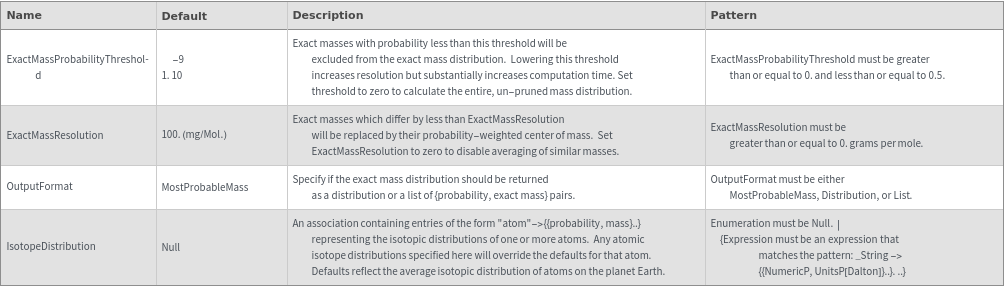
Exclude exact masses which occur with probability less than 10^-3:

Set the probability threshold and mass resolution to zero to do an exact calculation. Note that this can be computationally expensive, as even for small molecules there are a large number of possible exact masses:

ExactMassResolution  (2)

Combine the probability of exact masses which differ by less than ExactMassResolution, replacing these masses with their probability-weighted center of mass:

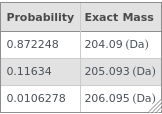
Set the ExactMassResolution to 0.0 Dalton to disable averaging of similar masses. Note that this may generate a very large number of possible masses:

IsotopeDistribution  (2)

Override the default isotope distribution of Carbon to be 100% Carbon-14:

Compute the ExactMass distribution of chloroform if the hydrogens are 99% deuterated:

OutputFormat  (3)

By default, only the most probable mass is returned:

Set OutputFormat to List to return a list of {{probability,exact mass}..} pairs representing the distribution of exact masses:


Set OutputFormat to Distribution to return a Mathematica distribution object representing the discrete distribution of exact masses:


Messages  (7)

DegenerateMassUncertain  (1)

The exact mass of a degenerate monomer is not defined, and the average molecular weight of possible degenerate substitutions will be used instead:

InvalidExtinctionCoefficientsModel  (1)

Show a warning if the Molecule field of input SLL object is not a valid Molecule[]:

missMatchPolymer  (1)

Return $Failed if the input Strand could not be resolved to a valid type:

MoleculeInfoNotFound  (1)

Show a warning if the Molecule field of input SLL object is not a valid Molecule[]:

nintrp  (1)

Return $Failed if an invalid Molecule[] is provided:

UndefinedMass  (1)

Show a warning if the Molecule field of input SLL object is not a valid Molecule[]:

UnknownComposition  (1)

If the molecular composition of a Modification or Monomer is undefined, its averaged molecular weight will be used as an approximation when calculating exact mass: