
UploadMolecule
UploadMolecule[MoleculeName]⟹Molecule
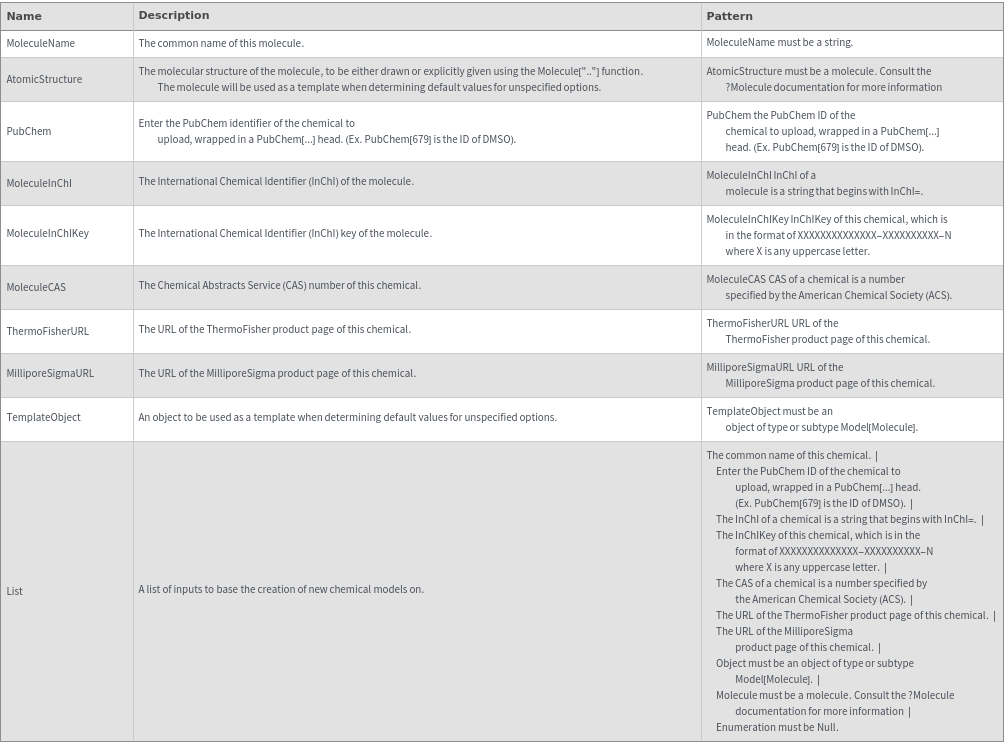
returns a model Molecule that contains the information given about the chemical sample.
UploadMolecule[AtomicStructure]⟹Molecule
returns a model Molecule based on the provided options and the structure specified by 'myMolecule'. The molecular structure of 'myMolecule' can be either drawn or explicitly given using the Molecule[".."] function.
UploadMolecule[PubChem]⟹Molecule
returns a model Molecule that contains the information given about the chemical sample.
UploadMolecule[MoleculeInChI]⟹Molecule
returns a model Molecule that contains the information given about the chemical sample.
UploadMolecule[MoleculeInChIKey]⟹Molecule
returns a model Molecule that contains the information given about the chemical sample.
UploadMolecule[MoleculeCAS]⟹Molecule
returns a model Molecule that contains the information given about the chemical sample.
UploadMolecule[ThermoFisherURL]⟹Molecule
returns a model Molecule that contains the information given about the chemical sample.
UploadMolecule[MilliporeSigmaURL]⟹Molecule
returns a model Molecule that contains the information given about the chemical sample.
UploadMolecule[TemplateObject]⟹Molecule
returns a model Molecule based on the provided options and the values found in TemplateObject.
UploadMolecule[]⟹Molecule
returns a model Molecule that contains the information given about the chemical sample.
UploadMolecule[List]⟹Molecules
returns an index-matched list of 'Molecules' that contains the information given about the chemical sample, based on the given list List.
Details
Input
Output

Analysis & Reports Options

Compatibility Options
Health & Safety Options
Input Processing Options

Organizational Information Options
Physical Properties Options
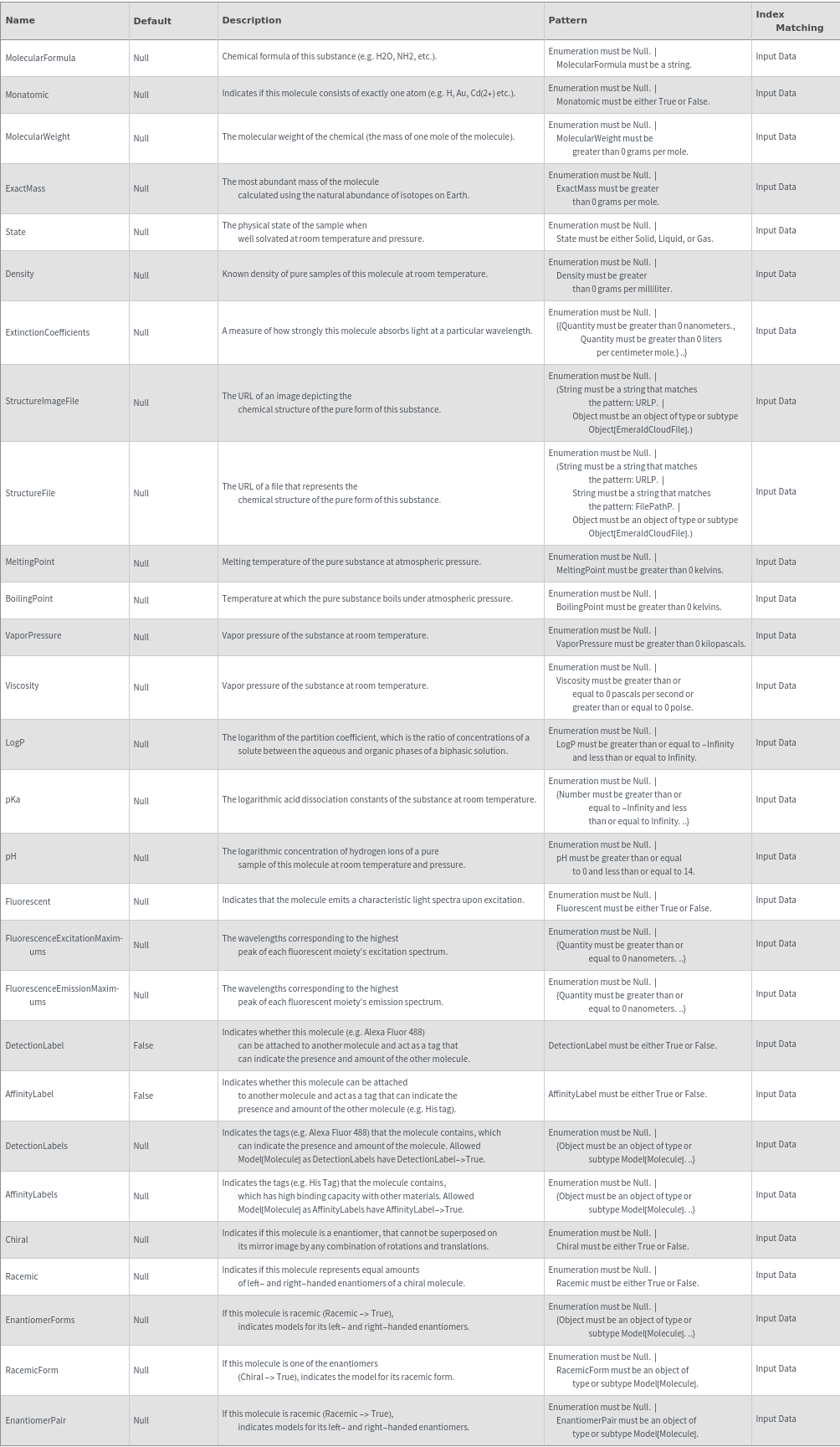
Storage Information Options

Examples
Basic Examples (5)










Additional Examples (4)








Options (58)


AffinityLabel (1)


AffinityLabels (1)




BiosafetyLevel (1)


BoilingPoint (1)




Chiral (1)




DetectionLabel (1)


DetectionLabels (1)


DOTHazardClass (1)


DrainDisposal (1)


EnantiomerForms (1)


EnantiomerPair (1)






ExtinctionCoefficients (1)






Fuming (1)


HazardousBan (1)


InChI (1)


InChIKey (1)


IncompatibleMaterials (2)
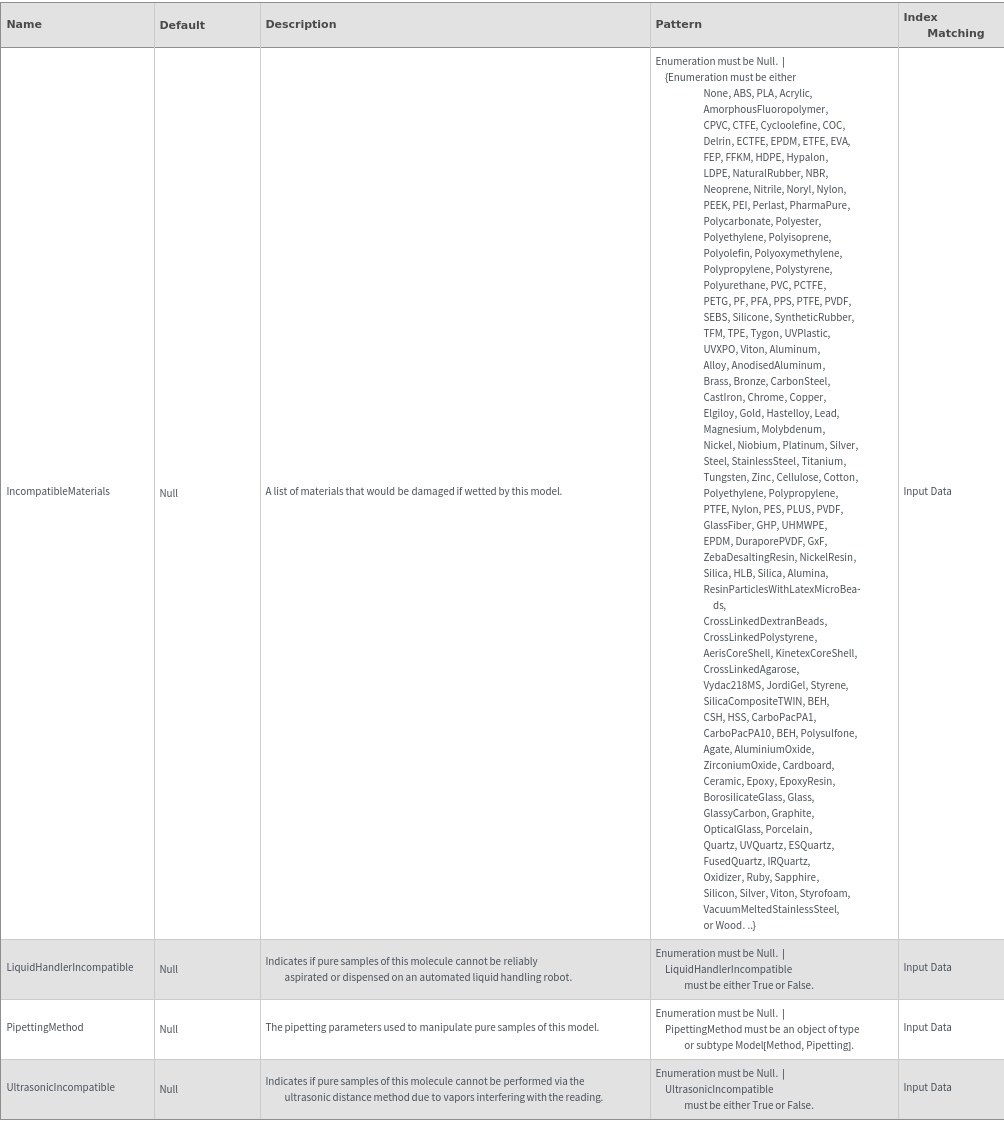
Use the IncompatibleMaterials option to specify the list of materials that would become damaged if wetted by this chemical sample. Use MaterialP to see the materials that can be used in this field. Specify {None} if there are no IncompatibleMaterials:


Use the IncompatibleMaterials option to specify the list of materials that would become damaged if wetted by this chemical sample. Use MaterialP to see the materials that can be used in this field. Specify {None} if there are no IncompatibleMaterials:




LightSensitive (1)


LiquidHandlerIncompatible (1)


MeltingPoint (1)


MolecularFormula (1)


MolecularWeight (1)



MonomerSymbol (1)


MSDSFile (1)


MSDSRequired (1)



NFPA (2)
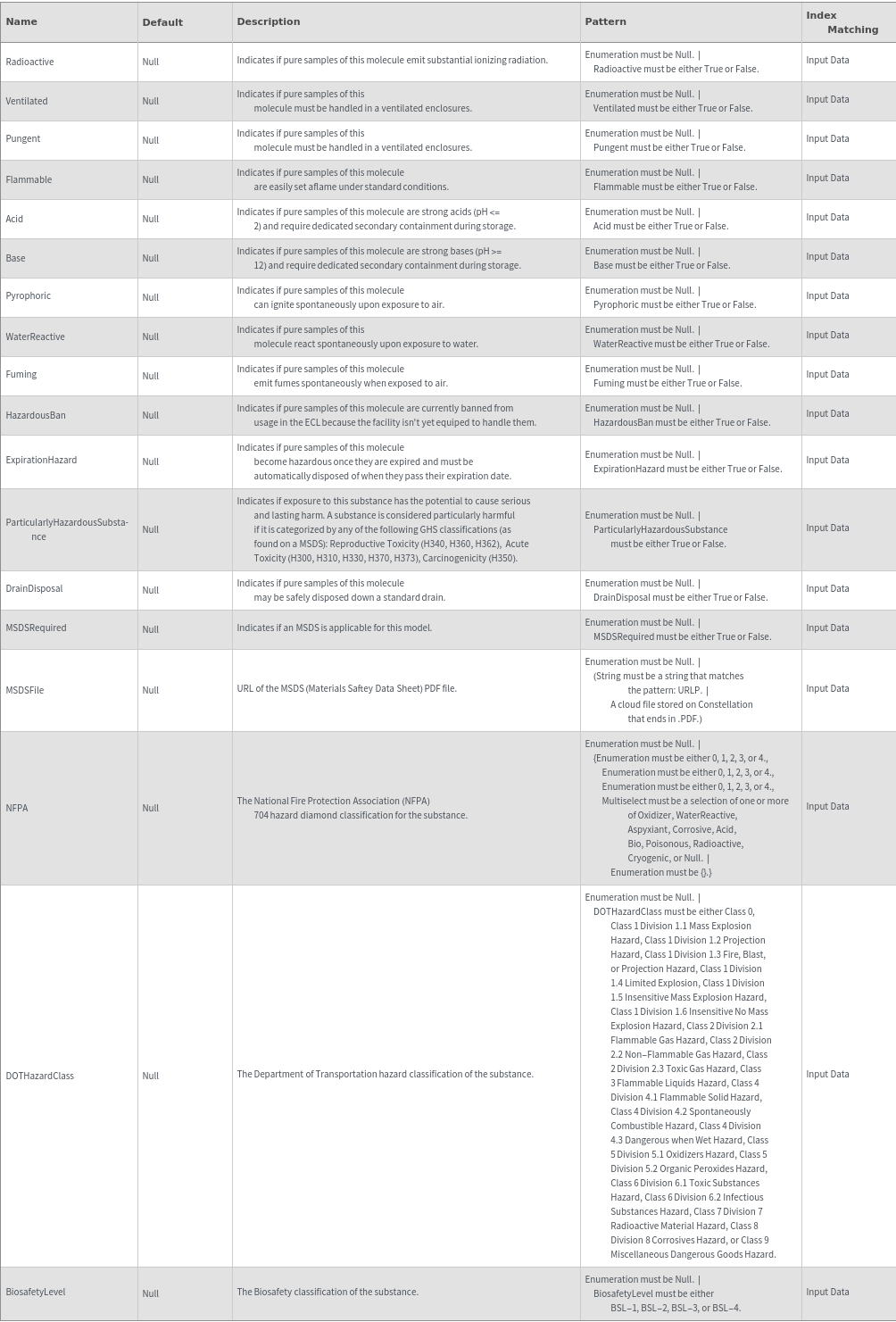
Use the NFPA option to specify the National Fire Protection Association (NFPA) 704 Hazard diamond classification of this substance. This option is specified in the format {HealthRating,FlammabilityRating,ReactivityRating,SpecialConsiderationsList}. The valid symbols to include in SpecialConsiderationsList are Oxidizer|WaterReactive|Aspyxiant|Corrosive|Acid|Bio|Poisonous|Radioactive|Cryogenic|Null. The following chemical, formaldehyde, as an NFPA of {3,0,0,{Radioactive}} which means that its Health rating is 3, its Flammability rating is 0, and its Reactivity rating is 0. The special consideration of this chemical is that it is radioactive:


Use the NFPA option to specify the National Fire Protection Association (NFPA) 704 Hazard diamond classification of this substance. This option is specified in the format {HealthRating,FlammabilityRating,ReactivityRating,SpecialConsiderationsList}. The valid symbols to include in SpecialConsiderationsList are Oxidizer|WaterReactive|Aspyxiant|Corrosive|Acid|Bio|Poisonous|Radioactive|Cryogenic|Null. The following chemical, water, has an NFPA of {0,0,0,{}} which means that its Health, Flammability, and Reactivity ratings are 0 and there are no special considerations to take into account:


ParticularlyHazardousSubstance (1)
Use the ParticularlyHazardousSubstance option to specify that special precautions should be taken in handling this substance. This option should be set if the GHS Classification of the chemical is any of the following: Reproductive Toxicity (H340, H360, H362), Acute Toxicity (H300, H310, H330, H370, H373), Carcinogenicity (H350):









































