UploadCarbohydrate
UploadCarbohydrate[Inputs]⟹CarbohydrateModel
creates/updates a model CarbohydrateModel that contains the information given about the carbohydrate.
UploadCarbohydrate[CarbohydrateName]⟹CarbohydrateModel
returns a new model CarbohydrateModel that contains the information given about the carbohydrate.
UploadCarbohydrate[CarbohydrateObject]⟹CarbohydrateModel
updates an existing model CarbohydrateModel that contains the information given about the carbohydrate.
Details
Input

Output

Analysis & Reports Options

Compatibility Options
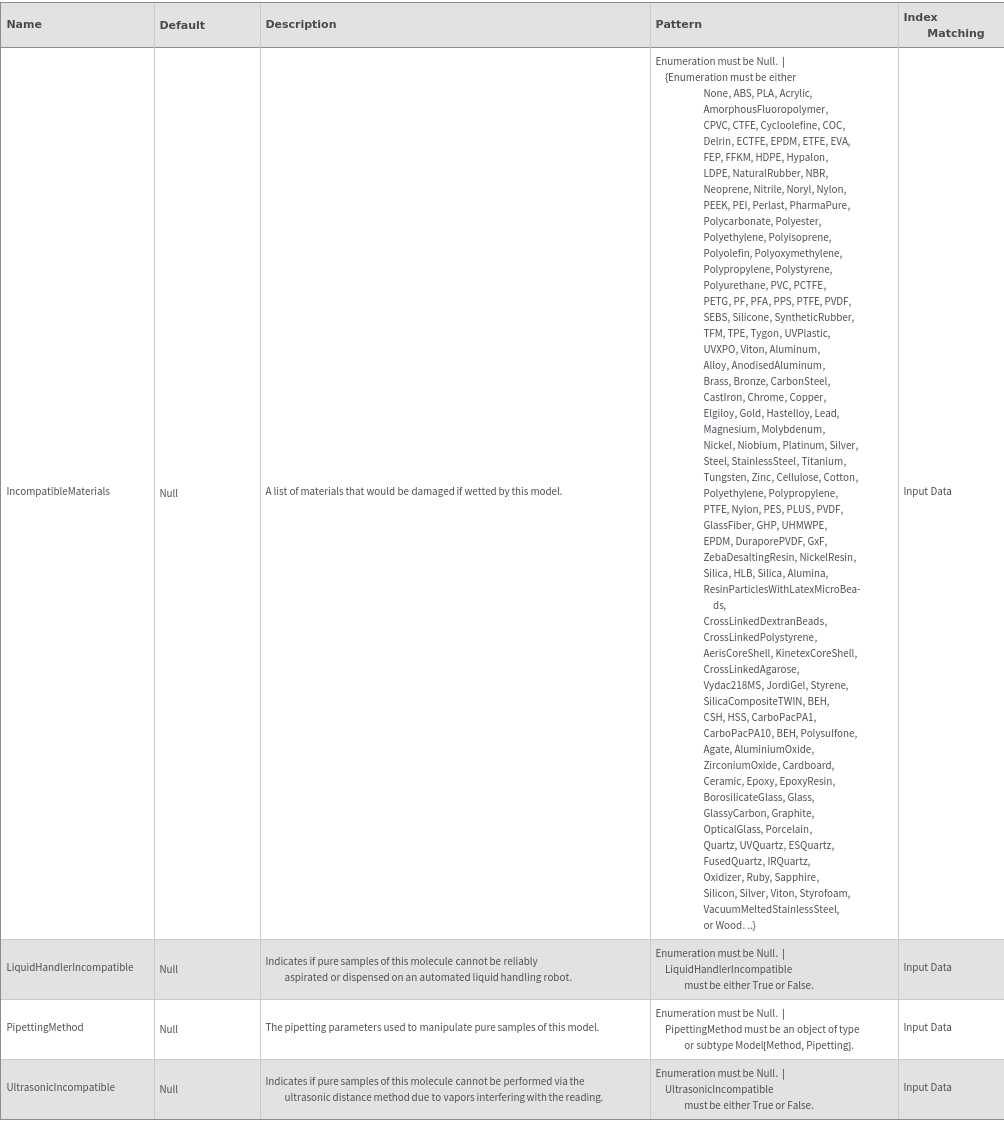
Health & Safety Options
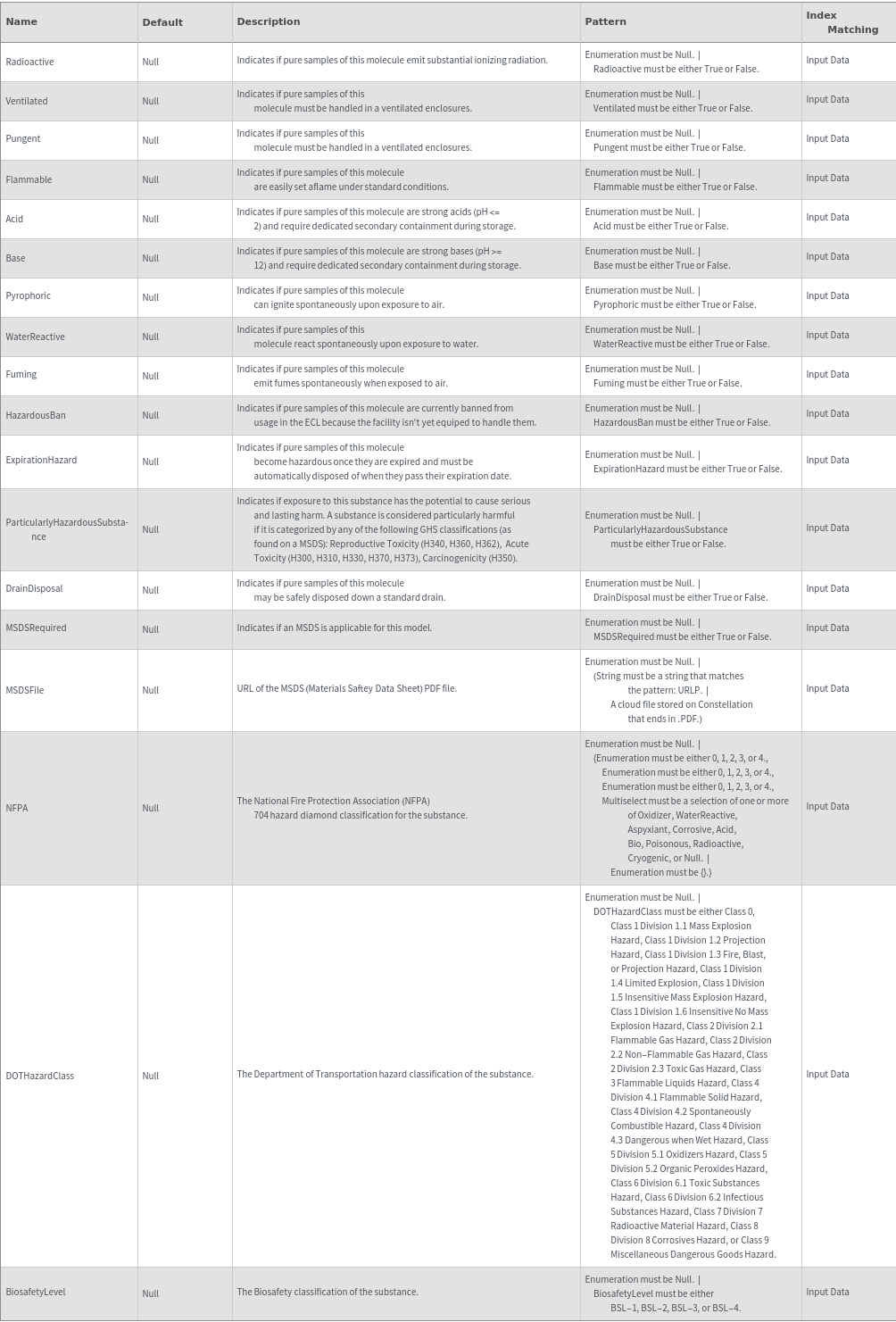
Input Processing Options

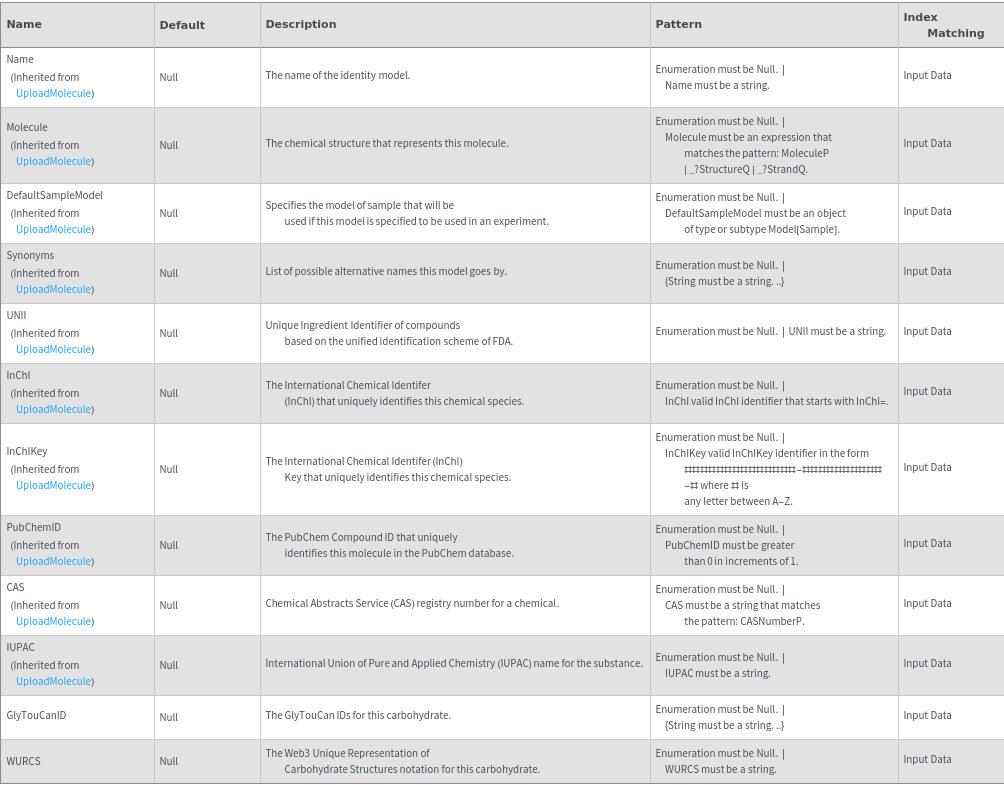
Organizational Information Options
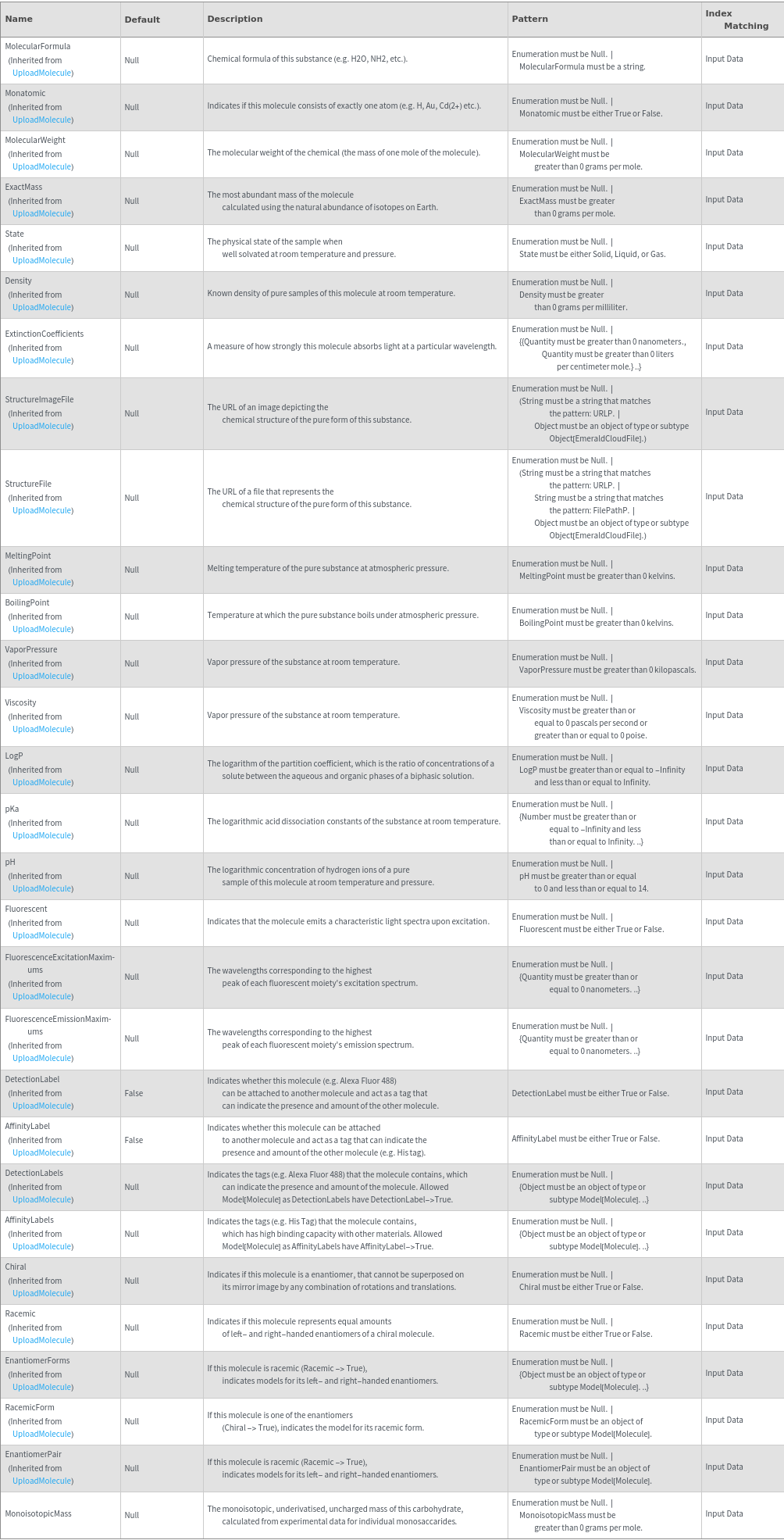
Physical Properties Options
Storage Information Options

Examples
Basic Examples (1)
Upload a model for a biological macromolecule composed of monosaccharide monomers:
Options (30)
Acid (1)
Use the Acid option to specify that pure samples of this identity model are strong acids:
Base (1)
Use the Base option to specify that pure samples of this identity model are strong bases:
BoilingPoint (1)
Use the BoilingPoint option to provide the temperature at which the liquid form of this identity model will evaporate:
Density (1)
Use the Density option to set the density of this uploaded identity model:
DetectionLabels (1)
Indicate the tags that the cell contains, which can indicate the presence and amount of particular features or molecules in the cell:
DOTHazardClass (1)
Use the DOTHazardClass option to set the DOT Hazard Class of this uploaded identity model. The valid values of this option can be found by evaluating DOTHazardClassP. The following identity model is part of DOT Hazard Class 0:
DrainDisposal (1)
Use the DrainDisposal option to specify that pure samples of this identity model can be safely disposed down a standard drain:
ExpirationHazard (1)
Use the ExpirationHazard option to indicate that samples that contain this identity model are hazardous when they become expired:
ExtinctionCoefficients (1)
Use the ExtinctionCoefficients option to set the Extinction Coefficient of this uploaded identity model. This field is in the format {{Wavelength,ExtinctionCoefficient}..}:
Fuming (1)
Use the Fuming option to specify that pure samples of this identity model produce fumes when exposed to air:
GlyTouCanID (1)
Specify the GlyTouCan IDs for this carbohydrate:
HazardousBan (1)
Use the HazardousBan option to indicate that sample that contain this identity model are currently banned from usage in the ECL because the facility isn't yet equipped to handle them:
LightSensitive (1)
Use the LightSensitive option to specify if the identity model is light sensitive and special precautions should be taken to make sure that samples that contain this identity model should be handled in a dark room:
LiquidHandlerIncompatible (1)
Use the LiquidHandlerIncompatible option to specify that pure samples of this identity model cannot be reliably aspirated or dispensed by a liquid handling robot (ex. Methanol):
LiteratureReferences (1)
Use the LiteratureReferences option to link to scholarly articles that mention this identity model:
MeltingPoint (1)
Use the MeltingPoint option to provide the temperature at which the solid form of this identity model will melt:
Name (1)
Use the Name option to set the name of this new identity model:
NFPA (1)
Use the NFPA option to specify the National Fire Potection Association (NFPA) 704 Hazard diamond classification of this substance. This option is specified in the format {HealthRating,FlammabilityRating,ReactivityRating,SpecialConsiderationsList}. The valid symbols to include in SpecialConsiderationsList are Oxidizer|WaterReactive|Aspyxiant|Corrosive|Acid|Bio|Poisonous|Radioactive|Cryogenic|Null. The following identity model, as an NFPA of {1,0,0,{Radioactive}} which means that its Health rating is 1, its Flammability rating is 0, and its Reactivity rating is 0. This identity model has no special considerations:
ParticularlyHazardousSubstance (1)
Use the ParticularlyHazardousSubstance option to specify that special precautions should be taken in handling samples that contain this identity model. This option should be set to True if the GHS Classification of the identity model is an of the following: Reproductive Toxicity (H340, H360, H362), Acute Toxicity (H300, H310, H330, H370, H373), Carcinogenicity (H350):
pH (1)
Use the pH option to specify the logarithmic concentration of hydrogen ions of a pure sample of this identity model at room temperature and pressure:
pKa (1)
Use the pKa option to specify the logarithmic acid dissociation constant for the hydrogen ions present in this identity model:
Pungent (1)
Use the Pungent option to indicate that pure samples of this identity model have a strong odor:
Pyrophoric (1)
Use the Pyrophoric option to specify that pure samples of this identity model ignite spontaneously with contact with air:
Radioactive (1)
Use the Radioactive option to specify if this pure samples of this identity model contain unstable atomic nucleuses which lose energy by radiation:
UltrasonicIncompatible (1)
Use the UltrasonicIncompatible option to specify that volume measurements of pure samples of this identity model cannot be performed via the ultrasonic distance method due to vapors interfering with the reading (ex. Methanol):
VaporPressure (1)
Use the VaporPressure option to provide the equilibrium pressure of this identity model when it is in thermodynamic equilibrium with its condensed phase:
Ventilated (1)
Use the Ventilated option to specify that the pure samples of this identity model need to be handled in a ventilated enclosure:
Viscosity (1)
Use the Viscosity option to provide the internal friction of this identity model, measured by the force per unit area resisting a flow between parallel layers of liquid:
WaterReactive (1)
Use the WaterReactive option to specify that pure samples of this identity model react violently with contact with water:
WURCS (1)
Specify the Web3 Unique Representation of Carbohydate Structures notation for this carbohydrate:
Last modified on Mon 24 Jun 2024 19:50:00



























































